How to Fix Blurry Vision Naturally: The 4 Most Common Causes After 60, What You Can Do at Home Today... and What I Would Do in Your Place

Dear Friend,
You pick up the newspaper and the letters seem to have shrunk.
You stretch your arm. You pull it closer. You look for more light.
At night the phone screen turns into a smear, and you wonder whether it is just tiredness or the start of something.
If that sounds familiar, stay with me for the next seven minutes.
Here is why:
You are about to find out the most common causes of blurry vision at our age, what you can do at home starting today, what only a doctor can fix… and, at the end, what I would do in your place.
First, the Warning That Can Save Your Sight
Before any home tip, read this twice.
Blurry vision that arrives suddenly is not a matter for home.
Go to the emergency room or call for help if you get:
- sudden blurring with eye pain, even more so if the eye is red [1];
- a shade or a curtain covering part of your sight [1];
- a sudden shower of new floaters, with or without flashes of light [9];
- double vision, even if it passes [1];
- blurring together with a drooping face, a weak arm or slurred speech. That can be a stroke, and it means calling 911 right away [10].
Nothing below is for those cases.
Now, if your sight has been getting blurry slowly, over months or years, keep reading.
The 4 Most Common Causes After 60
1. The lens has stiffened. After 40 the lens of the eye becomes more rigid and cannot change shape as easily as it used to. It is called presbyopia. There is no way to stop or reverse it, but it can be corrected with glasses [2].
2. Dry eye. We make fewer tears as we age, and the blur shows up mostly when reading. It is more common in women, especially after menopause. Several everyday medicines can cause it or make it worse: water pills, antihistamines, antidepressants, sleeping pills [4].
3. Cataracts. The lens slowly turns cloudy. Colors fade, lights glare, seeing at night gets hard. More than half of Americans aged 80 or older have cataracts or have had surgery for them [3].
4. Macular degeneration. It hits the center of your sight. Early on it gives no symptoms at all, which is why only an exam finds it. Eleven million people in the United States have it [5].
Notice one thing.
Two of those four do not announce themselves when they begin.
7 Things You Can Do Starting Today
- Book the eye exam. If you are over 60, the advice is a dilated eye exam every 1 to 2 years. Many eye diseases have no warning signs, and the exam is the only way to know [7].
- Update your glasses. It sounds obvious. But more than 150 million Americans have a refractive error, and many do not realize their sight could be better [11].
- Blink. In front of a screen we blink only 5 to 7 times a minute. The normal rate is about 15 [12]. An eye that does not blink dries out, and a dry eye blurs.
- Use artificial tears. They are the most common treatment for mild dry eye, and you can buy them without a prescription [6].
- Fix the light. A brighter lamp for reading. For screens, sit about 25 inches away and match the screen brightness to the room [12].
- Block the sun and drop the cigarettes. Wear sunglasses that block 99 to 100 percent of UVA and UVB. And smoking raises the risk of both cataracts and macular degeneration [8].
- Eat for your eyes. Dark leafy greens, and fish such as salmon and tuna. That is the official advice [8].
One truth about cataracts: no home tip removes one. Only surgery does. The good news is that nine in ten people who have it see better afterward [3].
Item 7 Is Where Almost Everybody Trips
The center of your retina holds two pigments, lutein and zeaxanthin. They come from your plate: kale, spinach, broccoli, egg yolks [13].
Now the number.
A typical American diet delivers 1 to 3 milligrams a day. The studies that linked diet to lower risk in the eyes talk about roughly 6 [13].
Be honest with me.
Do you eat kale every day?
Neither do I.
What I Would Do in Your Place
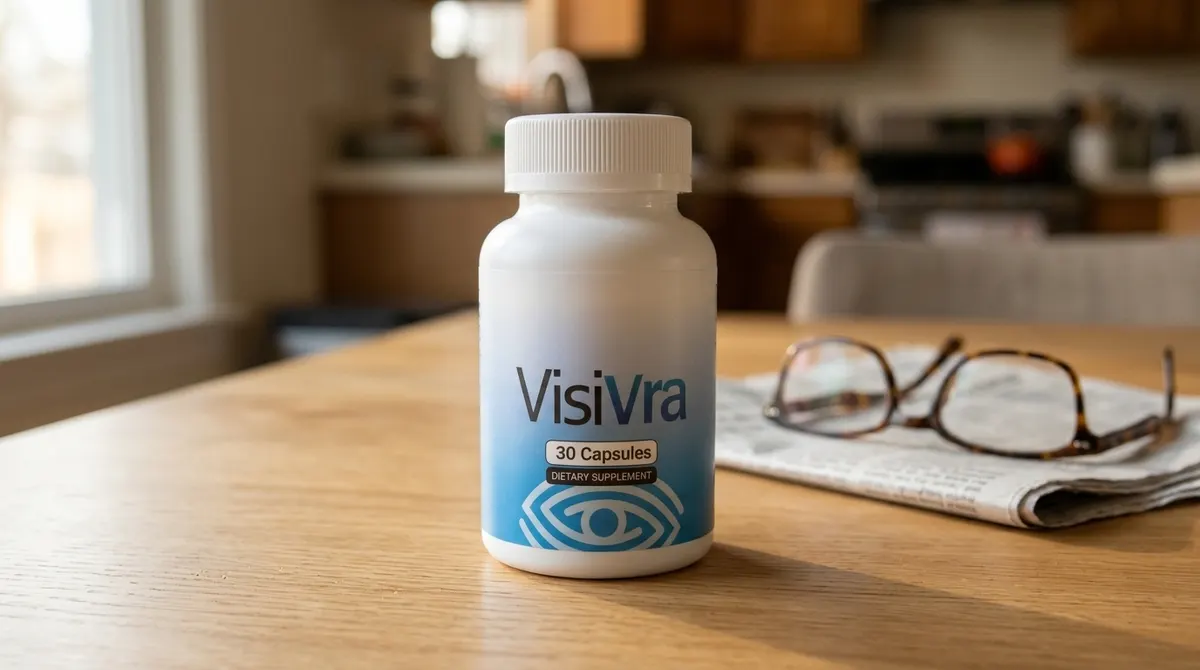
I would do all seven things on the list. And for item 7, I would not count on my plate alone.
The bottle I point people to is called Visivra.
It is one capsule a day, with six ingredients that vision research has studied for more than twenty years: lutein, zeaxanthin, zinc, astaxanthin, bilberry and vitamin A [17].
A few numbers, so you do not have to take my word for it:
- In a study of 3,640 people followed for more than six years, antioxidants plus zinc cut the odds of macular degeneration getting worse by about 28% [14].
- In a trial with 4,203 people, researchers named lutein and zeaxanthin a suitable replacement for beta carotene in the eye formula [15].
- In a six-week test, adults aged 40 and older held on to their sharpness better after hours of screen work with astaxanthin, on one of the measures [16].
Now two truths.
Visivra does not fix blurry vision. No supplement does. It does not replace the exam, the glasses or cataract surgery.
And the maker does not publish the milligrams of each ingredient [17]. The studies above are about the ingredients, not about the bottle.
So why do I point to it?
Because You Can Try It Without the Risk
The maker states a 60-day money-back guarantee on every order [17].
You order. You take one capsule a day, along with the other six things on the list. You pay attention to your reading, your screen, the end of your day.
You like what you notice? Good.
You do not? You ask for your money back inside the window.
The 6-Bottle Math
| Package | Price per bottle | Shipping |
|---|---|---|
| 2 bottles | $79 | $19.99 |
| 3 bottles | $69 | Free |
| 6 bottles | $49 | Free |
Prices from the official checkout [18].
Six bottles bought two at a time: $474, plus three shipping charges. The same six, bought at once: $294.
More than $180 of difference. For the same product.
And a nutrient takes time. The fastest study I mentioned ran six weeks [16].
How to Order
- Click the button below. It opens the official page.
- Choose the 6-bottle package.
- Fill in your address and payment.
- When the box arrives, write the date on the lid of the first bottle.
Sincerely,
Julius Smith
Julius Smith, Editor
P.S. Do one thing for me, whether you order or not: book your eye exam this week. Two of the four causes give no warning [5][7].
P.P.S. If your vision blurs suddenly, with pain, a shadow or flashes, forget this letter and go to the emergency room [1].
Frequently asked questions
Tap a question to read the answer.
When is blurry vision an emergency?
MedlinePlus lists sudden blurred vision with eye pain, especially with a red eye, as a medical emergency, along with loss of vision, double vision, and a shade or curtain across your sight, even if they pass [1]. Blurry vision with signs of a stroke means calling 911 [10].
How often should someone over 60 have an eye exam?
The National Eye Institute says to get a dilated eye exam every 1 to 2 years if you are over 60 [7]. People with diabetes or high blood pressure usually need one at least once a year [7].
Can blurry vision from cataracts be fixed without surgery?
Brighter lights, anti-glare sunglasses and magnifiers can help early on, but surgery is the only way to remove a cataract. Nine in ten people who have it see better afterward [3].
Can a supplement fix blurry vision?
No. None of the sources on this page says a food or a supplement fixes blurry vision. An eye exam finds the cause, and the cause decides the fix.
Sources
- MedlinePlus. Vision problems., accessed November 23, 2026.
- American Academy of Ophthalmology. What Is Presbyopia?, accessed November 23, 2026.
- National Eye Institute. Cataracts., accessed November 23, 2026.
- American Academy of Ophthalmology. What Is Dry Eye?, accessed November 23, 2026.
- National Eye Institute. Age-Related Macular Degeneration (AMD)., accessed November 23, 2026.
- National Eye Institute. Dry Eye., accessed November 23, 2026.
- National Eye Institute. Get a dilated eye exam., accessed November 23, 2026.
- National Eye Institute. Keep Your Eyes Healthy., accessed November 23, 2026.
- National Eye Institute. Floaters., accessed November 23, 2026.
- MedlinePlus. Stroke., accessed November 23, 2026.
- National Eye Institute. Refractive Errors., accessed November 23, 2026.
- American Academy of Ophthalmology. Computers, Digital Devices, and Eye Strain., accessed November 23, 2026.
- Abdel-Aal ESM, et al. Dietary sources of lutein and zeaxanthin carotenoids and their role in eye health. Nutrients, 2013., accessed November 22, 2026.
- Age-Related Eye Disease Study Research Group. AREDS report no. 8. Archives of Ophthalmology, 2001., accessed November 22, 2026.
- Age-Related Eye Disease Study 2 Research Group. The AREDS2 randomized clinical trial. JAMA, 2013., accessed November 22, 2026.
- Sekikawa T, et al. Effects of diet containing astaxanthin on visual function in healthy individuals. Journal of Clinical Biochemistry and Nutrition, 2023., accessed November 22, 2026.
- Visivra, the maker's page (ingredient names, package sizes, 60-day guarantee as stated by the maker)., accessed November 21, 2026.
- Visivra official checkout, 6-bottle package (prices and shipping for the three packages)., accessed November 21, 2026.
Read next
These statements have not been evaluated by the Food and Drug Administration. This product is not intended to diagnose, treat, cure, or prevent any disease.